
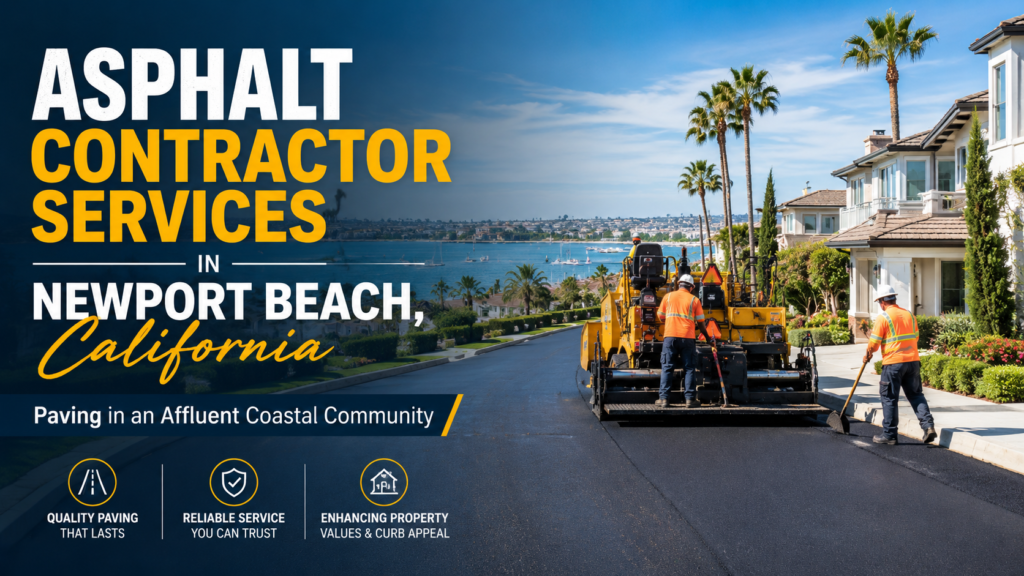
Newport Beach, California occupies a unique position in the Orange County landscape a coastal city of exceptional wealth and beauty, built along a natural harbor that makes it one of Southern California’s most sought-after addresses. With its mix of waterfront estates, resort hotels, luxury retail, active marinas, and established residential neighborhoods ranging from Balboa Island to Newport Coast, Newport Beach presents a distinctive set of paving needs shaped by coastal environmental conditions, premium aesthetic expectations, and the specific infrastructure demands of a community whose roads, driveways, and parking areas must serve both year-round residents and the substantial visitor traffic the city attracts. Asphalt Contractor Newport Beach working in Newport Beach understand that this is not an average paving market quality standards, appearance expectations, and the technical requirements of coastal paving are all elevated.
The Coastal Environment and Its Impact on Asphalt
Newport Beach’s position directly on the Pacific coast creates environmental conditions that affect asphalt performance in ways not found in inland Orange County communities. The primary coastal factors are:
- Salt air exposure: The marine layer that characterizes Newport Beach’s climate delivers salt aerosols that settle on paved surfaces. Salt accelerates the oxidation of asphalt binder, causes surface deterioration, and can affect the metal components of drainage infrastructure. For Newport Beach properties, this means asphalt maintenance schedules particularly sealcoating should be somewhat more aggressive than for properties just a few miles inland.
- Marine layer and moisture: Newport Beach’s famous morning marine layer introduces consistent moisture to paved surfaces. While the city’s annual rainfall is modest (approximately 13 inches), the daily moisture from marine layer condensation keeps surfaces wet for extended periods during early morning hours. This moisture, cycling on and off asphalt surfaces daily, contributes to binder degradation and can infiltrate surface cracks to reach the base layer.
- UV intensity: Despite the marine layer in the morning, Newport Beach receives intense afternoon and evening sun. The combination of UV exposure and salt air creates an environment where UV oxidation of asphalt binder proceeds more rapidly than in purely inland locations. Keeping surfaces protected with regular sealcoating is particularly important in this coastal environment.
- Thermal moderation: Newport Beach’s coastal location moderates temperature extremes compared to inland Orange County cities. Summer highs are typically 10 to 15 degrees cooler than Irvine, and winters are mild. This reduces the thermal stress on asphalt somewhat, but the binder must still be specified for the region’s temperature range.
Residential Asphalt Paving in Newport Beach
Newport Beach’s residential neighborhoods range from the compact Flower Streets of Corona del Mar and the historic bungalows of Balboa Peninsula to the expansive estates of Newport Coast and Harbor View Hills. This range produces correspondingly varied residential paving contexts, but all share the common thread of high property values and strong aesthetic expectations.
In Newport Beach’s premium residential neighborhoods, a driveway is not merely a functional surface it is a significant element of the property’s curb appeal and market value. Property owners here are typically willing to invest in quality materials and execution, and many properties feature premium paving treatments including pavers, stamped concrete, or high-quality asphalt with precise edge detailing that complements the property’s architecture and landscaping.
For properties where asphalt is the chosen surface, quality residential installation in Newport Beach includes:
- Thorough sub-base preparation: Excavation to the required depth, installation of a Class II base of appropriate depth (typically 3 to 4 inches for driveways, more for heavier-use surfaces), and compaction to achieve the structural support required.
- Appropriate drainage design: Driveways must slope away from structures and toward appropriate outlets. In Newport Beach’s compact residential neighborhoods particularly in areas like Balboa Island where lots are small and neighboring structures are close precise drainage management is essential.
- Quality asphalt mix: California-specification asphalt with the appropriate performance-grade binder for coastal Orange County conditions.
- Clean edge detailing: Professional edge compaction and finishing that produces sharp, well-defined borders appropriate to Newport Beach’s premium residential context.
Commercial Asphalt Maintenance in Newport Beach
Newport Beach’s commercial environment centers on several distinct activity areas: Fashion Island (one of Southern California’s premier open-air retail centers), the Mariner’s Mile waterfront commercial corridor, Balboa Village, and the numerous restaurants, hotels, and service businesses throughout the city. Each of these commercial settings generates regular asphalt maintenance needs, and the standard of maintenance expected in Newport Beach is consistent with the premium character of the market.
Fashion Island and similar high-visibility commercial properties in Newport Beach are maintained to appearance standards that go beyond the functional requirements of pavement. Fresh, dark sealcoating and crisp, bright restriping are routine annual investments for properties where customer and visitor first impressions are commercially important. Pothole repair and crack sealing are addressed promptly rather than deferred, both because of the safety and liability implications and because deteriorated pavement is incompatible with the property’s brand presentation.
For the hospitality properties hotels, resorts, and restaurant clusters that are central to Newport Beach’s economy, parking lot condition is an extension of the guest experience. Properties like the Balboa Bay Resort and the various luxury hotels along the coast maintain their paving to standards that reflect the quality their guests expect throughout their visit.
Marina and Harbor-Adjacent Paving
Newport Beach’s extensive harbor and marina infrastructure creates paving applications specific to this coastal city. The access roads, parking areas, and service lanes serving the marinas, boat launches, and harbor-adjacent commercial areas experience unique loading conditions and environmental stresses:
- Boat trailer traffic: Boat trailers are heavy, wide, and slow-moving, creating high point loads on pavement surfaces. Areas used regularly for boat launching and retrieval require asphalt specified and built for this loading type typically with thicker base courses and heavier-duty surface mixes than standard light vehicle applications.
- Marine fuel and petroleum exposure: Fuel docks and marina service areas expose pavement to petroleum products that degrade standard asphalt binder. In these areas, fuel-resistant asphalt products or alternative surfacing materials may be appropriate.
- Salt water contact: Direct spray and runoff from tidal areas introduces saltwater to adjacent paving. Regular washing to remove salt deposits and more frequent sealcoating applications help mitigate accelerated deterioration in these zones.
ADA Compliance in Newport Beach’s Commercial Parking Facilities
California’s Title 24 accessibility requirements which incorporate and often exceed the federal ADA standards apply to all commercial parking facilities in Newport Beach. The specific Newport Beach context adds complexity because many of the city’s commercial properties are in older buildings and parking areas that predate current accessibility standards.
When asphalt resurfacing or overlay work is performed on a Newport Beach commercial parking lot, California law requires that the scope of work include accessibility improvements if the existing parking does not meet current standards. This is a frequently misunderstood point a resurfacing project triggers an obligation to bring accessible parking spaces and accessible routes up to current standards, not just to restore the new surface layer. Experienced asphalt contractors in Newport Beach understand this requirement and incorporate ADA review into the scope of any commercial resurfacing project.
Specific ADA elements that must be addressed include: the number of accessible spaces (scaled to the total lot size), the dimensions of accessible spaces and access aisles, the slope of accessible spaces (maximum 2 percent in any direction), the signage for accessible spaces, and the accessibility of the route from accessible spaces to the building entrance.
Permits and City of Newport Beach Requirements
Asphalt paving work in Newport Beach that involves curb cuts or modifications to connections with public streets requires an encroachment permit from the City of Newport Beach Public Works Department. The City also requires that work within the public right-of-way which can include the sidewalk, parkway, and curb apron areas adjacent to private property be performed by licensed contractors who meet the City’s insurance requirements.
For larger commercial projects involving significant site modifications, drainage changes, or new construction, the Newport Beach Planning Division may have additional review requirements. Asphalt contractors experienced in Newport Beach are familiar with the city’s permit processes and can guide property owners through the applicable requirements for their specific project.
Sealcoating: The Most Important Maintenance Practice for Newport Beach Asphalt
Given Newport Beach’s combination of coastal UV intensity, salt air, and daily marine layer moisture, sealcoating is the single most impactful maintenance practice for asphalt surfaces in the city. Quality sealcoating applied on a regular two to three year cycle:
- Creates a barrier between the asphalt binder and UV radiation, slowing oxidation and binder hardening.
- Seals surface porosity against moisture infiltration and salt penetration.
- Protects against the petroleum products common in coastal commercial environments fuel, oils, and cleaning compounds.
- Restores the dark, uniform appearance of fresh asphalt, maintaining the curb appeal that is particularly valued in Newport Beach’s premium property market.
New asphalt should be sealcoated approximately six to twelve months after installation. Applying sealcoat before the asphalt has fully cured can trap gases from the curing process and produce a finish that bubbles or peels. After the first application, sealcoating every two to three years is appropriate for most Newport Beach applications, with coastal properties near the harbor potentially benefiting from a more frequent cycle.
Conclusion
Asphalt contractor services in Newport Beach operate in a premium coastal environment where aesthetic expectations, salt air and UV stresses, ADA compliance requirements, and the specific loading conditions of harbor and marina-adjacent facilities all shape what quality paving work requires. Property owners and facilities managers in Newport Beach who understand these factors and who work with asphalt contractors experienced in coastal Orange County conditions invest in pavement that performs reliably, looks consistently excellent, and holds up against the specific stresses of one of California’s most beautiful and demanding coastal communities.